
Gaslighting is one of the most insidious forms of emotional abuse. It works by quietly dismantling your trust in your own mind, leaving you confused, anxious, and increasingly dependent on your abuser for your sense of reality. And the most dangerous thing about it? It happens so gradually that most people don’t realise it’s happening until they’re deep in its grip.
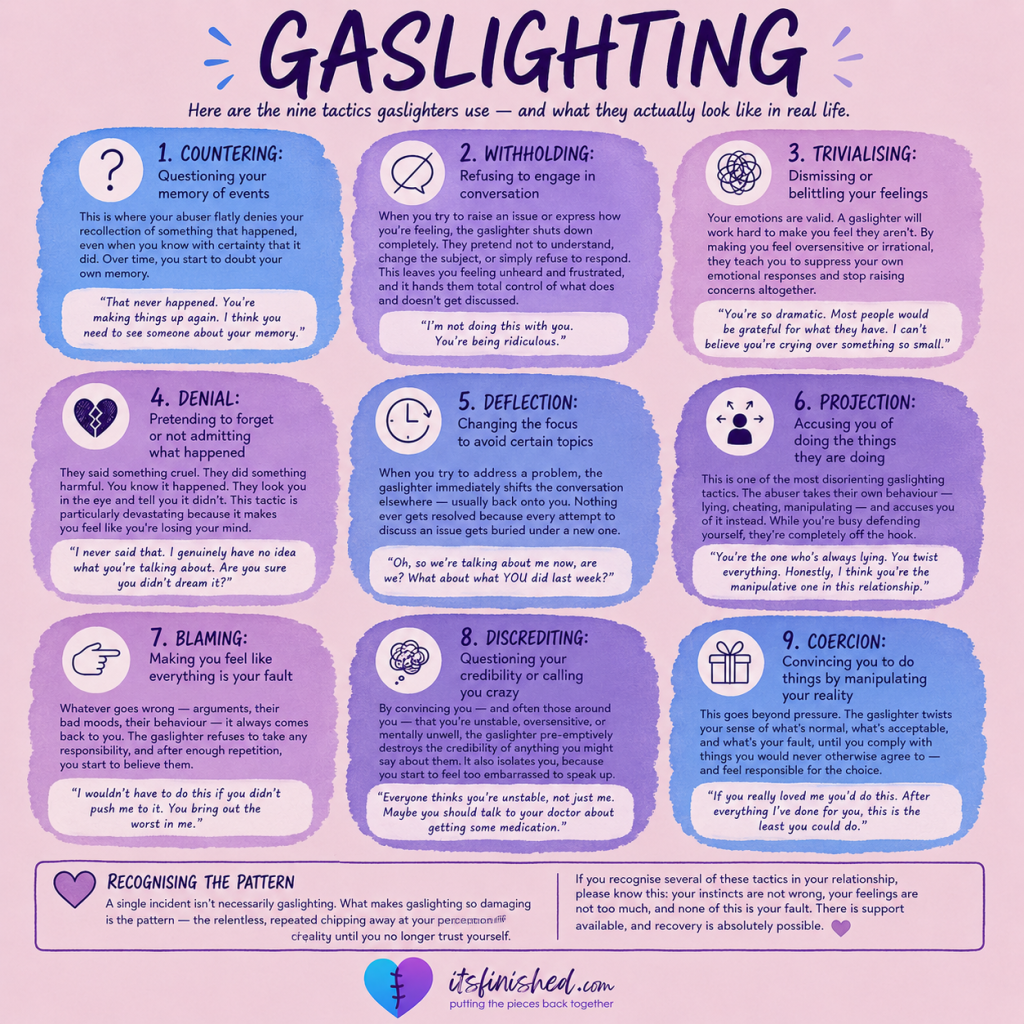
Here are the nine tactics gaslighters use — and what they actually look like in real life.
Countering: Questioning your memory of events
This is where your abuser flatly denies your recollection of something that happened, even when you know with certainty that it did. Over time, you start to doubt your own memory.
“That never happened. You’re making things up again. I think you need to see someone about your memory.”
Withholding: Refusing to engage in conversation
When you try to raise an issue or express how you’re feeling, the gaslighter shuts down completely. They pretend not to understand, change the subject, or simply refuse to respond. This leaves you feeling unheard and frustrated, and it hands them total control of what does and doesn’t get discussed.
“I’m not doing this with you. You’re being ridiculous.”
Trivialising: Dismissing or belittling your feelings
Your emotions are valid. A gaslighter will work hard to make you feel they aren’t. By making you feel oversensitive or irrational, they teach you to suppress your own emotional responses and stop raising concerns altogether.
“You’re so dramatic. Most people would be grateful for what they have. I can’t believe you’re crying over something so small.”
Denial: Pretending to forget or not admitting what happened
They said something cruel. They did something harmful. You know it happened. They look you in the eye and tell you it didn’t. This tactic is particularly devastating because it makes you feel like you’re losing your mind.
“I never said that. I genuinely have no idea what you’re talking about. Are you sure you didn’t dream it?”
Deflection: Changing the focus to avoid certain topics
When you try to address a problem, the gaslighter immediately shifts the conversation elsewhere — usually back onto you. Nothing ever gets resolved because every attempt to discuss an issue gets buried under a new one.
“Oh, so we’re talking about me now, are we? What about what YOU did last week?”
Projection: Accusing you of doing the things they are doing
This is one of the most disorienting gaslighting tactics. The abuser takes their own behaviour — lying, cheating, manipulating — and accuses you of it instead. While you’re busy defending yourself, they’re completely off the hook.
“You’re the one who’s always lying. You twist everything. Honestly, I think you’re the manipulative one in this relationship.”
Blaming: Making you feel like everything is your fault
Whatever goes wrong — arguments, their bad moods, their behaviour — it always comes back to you. The gaslighter refuses to take any responsibility, and after enough repetition, you start to believe them.
“I wouldn’t have to do this if you didn’t push me to it. You bring out the worst in me.”
Discrediting: Questioning your credibility or calling you crazy
By convincing you — and often those around you — that you’re unstable, oversensitive, or mentally unwell, the gaslighter pre-emptively destroys the credibility of anything you might say about them. It also isolates you, because you start to feel too embarrassed to speak up.
“Everyone thinks you’re unstable, not just me. Maybe you should talk to your doctor about getting some medication.”
Coercion: Convincing you to do things by manipulating your reality
This goes beyond pressure. The gaslighter twists your sense of what’s normal, what’s acceptable, and what’s your fault, until you comply with things you would never otherwise agree to — and feel responsible for the choice.
“If you really loved me you’d do this. After everything I’ve done for you, this is the least you could do.”
Recognising the pattern
A single incident isn’t necessarily gaslighting. What makes gaslighting so damaging is the pattern — the relentless, repeated chipping away at your perception of reality until you no longer trust yourself.
If you recognise several of these tactics in your relationship, please know this: your instincts are not wrong, your feelings are not too much, and none of this is your fault. There is support available, and recovery is absolutely possible.