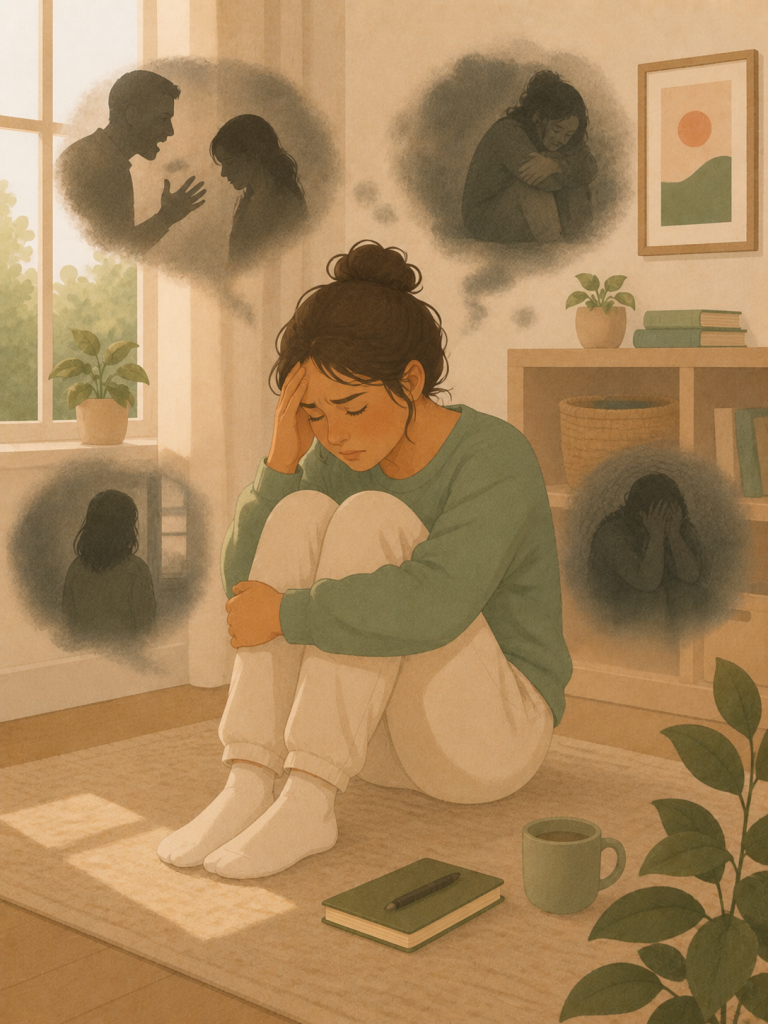

Post-traumatic stress disorder — PTSD — is a real, well-documented mental health condition that can develop after experiencing traumatic events. Most people associate it with war or disaster. However, domestic abuse, coercive control, emotional abuse and prolonged fear within a relationship are among the most common causes of PTSD there is.
If you have left an abusive relationship and find yourself struggling in ways you did not expect — unable to relax, easily startled, plagued by intrusive memories or simply feeling like your mind and body will not settle — this article is for you. What you are experiencing has a name, it has an explanation, and it is not a sign that something is permanently wrong with you.
Why Abuse Causes Trauma
Trauma does not require a single catastrophic event. For many survivors of domestic abuse, it develops slowly and quietly over months or years — through sustained fear, unpredictability, manipulation and the relentless stress of living with someone who caused harm.
Many people stay in survival mode for so long that they do not fully notice the impact until the relationship ends. Once they finally feel safe enough to stop functioning on adrenaline, the weight of everything they carried comes to the surface. This is not a breakdown. Instead, it is the nervous system finally beginning to process what it lived through.
PTSD: What It Is and How It Shows Up
PTSD develops when the nervous system becomes stuck in a threat response — continuing to behave as though danger is present long after it has passed. It affects emotions, thoughts, sleep, physical health and relationships.
Common symptoms include:
- Flashbacks or intrusive memories of specific incidents
- Nightmares related to the abuse or relationship
- Panic attacks or sudden intense anxiety
- Hypervigilance — a persistent sense of being on edge or waiting for something bad to happen
- Emotional numbness or feeling detached from yourself or others
- Difficulty relaxing, concentrating or sleeping
- Being easily startled by sounds, movement or conflict
- Avoiding anything that reminds you of the trauma — places, people, smells, sounds
- Feeling unsafe even in objectively calm situations
- Irritability or emotional overwhelm that feels disproportionate
Symptoms vary significantly between people. Some experience them immediately after leaving. Others find that symptoms emerge months or even years later — which can feel confusing, particularly if they believed they had already moved on.
CPTSD: When the Trauma Was Ongoing
Complex PTSD — CPTSD — is a distinct but related condition. It develops specifically in response to prolonged, repeated trauma rather than a single event. As a result, it is particularly relevant for survivors of domestic abuse, coercive control and long-term emotional or psychological harm.
Where PTSD often connects to specific memories or triggers from a particular incident, CPTSD reflects the cumulative impact of sustained harm over time. It tends to go deeper — into identity, self-worth and the capacity to feel safe in relationships.
In addition to the symptoms of PTSD, CPTSD commonly involves:
- Profound and persistent shame — a deep sense of being fundamentally flawed or worthless
- Difficulty regulating emotions — intense responses that feel impossible to control or predict
- A distorted sense of self — struggling to know who you are, what you feel or what you deserve
- Persistent feelings of hopelessness or emptiness
- Difficulty trusting others or feeling safe in close relationships
- A tendency to re-enter unhealthy relationships because familiar dynamics feel safer than unknown ones
- Dissociation — feeling detached from your body, your surroundings or your sense of reality
CPTSD is not yet included in the DSM-5 used in the United States. However, it is formally recognised in the ICD-11 — the diagnostic framework used in the UK — and many trauma-informed therapists work with it as a distinct and important diagnosis.
If you feel like the damage goes beyond anxiety or bad memories — like it has reached something fundamental about how you see yourself — CPTSD may be a more accurate framework for understanding your experience.
Hypervigilance: When Your Body Will Not Switch Off
One of the most exhausting symptoms of both PTSD and CPTSD is hypervigilance. After spending months or years monitoring another person’s moods and anticipating danger, your nervous system learns to stay permanently alert.
That alertness does not simply switch off when the danger ends. You may find yourself constantly scanning for problems, overreacting to raised voices, feeling tense around people you trust, or struggling to relax even in situations that are objectively safe. Many survivors describe feeling perpetually braced — waiting for something to go wrong even when nothing is.
This is not ordinary anxiety. It is a nervous system conditioned by prolonged threat that has not yet received the message that the threat is over. Importantly, it responds well to treatment and does settle over time.
Triggers: Why Ordinary Things Can Feel Overwhelming
A trigger is anything that causes the nervous system to react as though past danger is happening again right now. Triggers are often sensory — a tone of voice, a smell, a particular silence, the sound of a door. The response they produce can feel sudden, intense and completely disproportionate to the actual situation.
Common triggers for abuse survivors include raised voices, phone notifications, conflict between other people, certain places or times of year, and encountering anyone who resembles the person who caused harm. The brain is not overreacting — it is doing exactly what it learned to do. It treats those signals as warnings because, for a long time, they were.
Understanding your triggers does not make them disappear immediately. However, knowing why your body responds the way it does transforms an overwhelming mystery into something you can begin to work with.
How Trauma Lives in the Body
PTSD and CPTSD are not only emotional — they are physical. Trauma lodges in the body, and the nervous system keeps the score long after the mind has tried to move on.
Survivors commonly experience fatigue, chronic muscle tension, headaches, digestive problems, a racing heart in calm situations and a persistent physical sense of unease. These are not imagined symptoms. They are the body’s ongoing stress response, and they respond to the same trauma-informed approaches that help the mind heal.
Healing From PTSD and CPTSD
Both conditions are treatable. Recovery takes time and rarely follows a straight line — nevertheless, it is real and achievable, including for people who have carried these symptoms for years.
Trauma-focused therapy is the most effective route for most people. EMDR — Eye Movement Desensitisation and Reprocessing — carries a strong evidence base for PTSD. It works by helping the brain process traumatic memories that have become stuck. Trauma-focused Cognitive Behavioural Therapy is another well-evidenced approach. For CPTSD specifically, where the work often goes deeper into identity, shame and relational patterns, longer-term trauma-informed therapy is generally recommended.
Alongside therapy, several things support recovery:
- Learning about trauma and understanding your own responses — knowledge genuinely reduces shame
- Grounding techniques that help regulate the nervous system in difficult moments
- Gentle, consistent movement — the body needs to discharge stored stress
- Rebuilding safe, trustworthy relationships gradually and at your own pace
- Rest, without guilt, as a legitimate and necessary part of healing
- Reducing ongoing exposure to stress wherever possible
Working With a Therapist Who Understands
Understanding what you are experiencing is a powerful first step. However, working through PTSD or CPTSD alone is genuinely difficult — and for most people, the right therapeutic support makes an enormous difference to both the pace and depth of recovery.
Offering therapy specialising in trauma and abuse recovery, itsfinished.com works with survivors who are ready to understand what happened, make sense of how it has affected them and begin building something different. If you would like to explore working together, you can find out more on our therapy page.
You Are Not Broken
PTSD and CPTSD are not signs of weakness or an inability to cope. They are signs that your mind and body responded to prolonged, serious harm in the way human nervous systems are designed to respond. The problem is not you — it is what was done to you and the mark it left.
Many people who have lived with these symptoms for years go on to recover fully. Not just managing symptoms — but genuinely rebuilding a life that feels safe, grounded and their own. For most people who find the right support, that is not an unrealistic hope. It is simply what comes next.