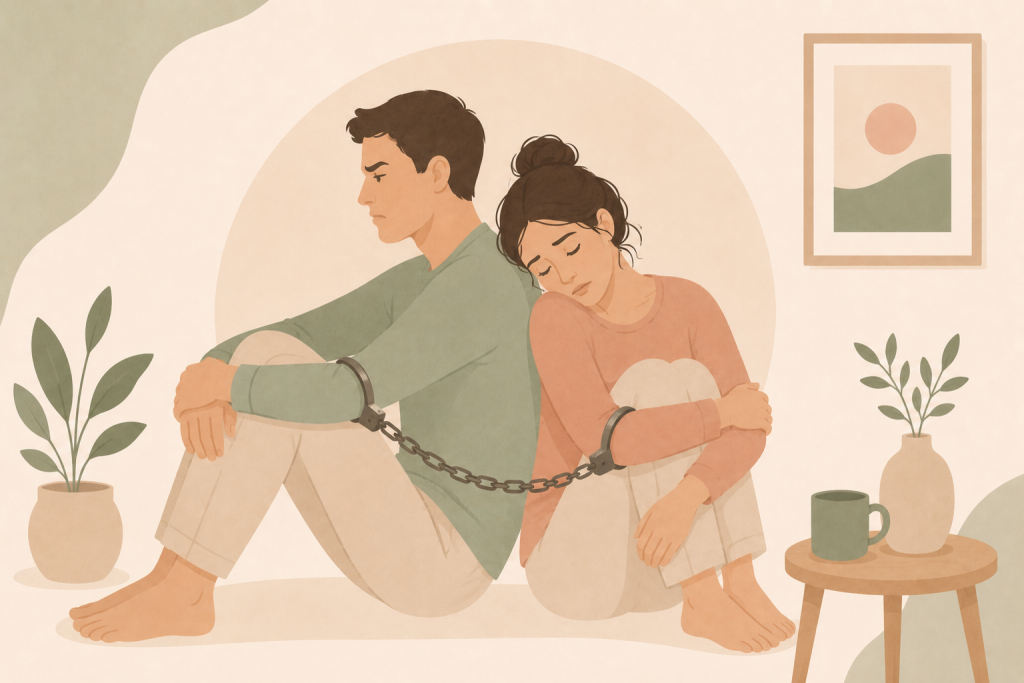

Trauma bonding is a powerful psychological attachment that forms between a person and someone who causes them harm. It develops not in spite of the abuse, but often because of it — and that is what makes it so difficult to understand from the outside.
If you have ever stayed in a relationship that you knew was hurting you, found yourself defending someone who repeatedly let you down, or felt an intense pull back to a person after they had caused you pain, you may have experienced trauma bonding. It does not mean you are weak or foolish. It means your mind responded to an extremely difficult situation in a very human way.
Why Trauma Bonds Form
Trauma bonds develop through cycles of harm followed by relief. When someone hurts you and then shows kindness, affection or remorse, your brain registers that shift as a reward. Over time, the pattern of tension, pain and reconciliation creates a chemical response similar to addiction.
The unpredictability plays a significant role. Intermittent reinforcement — where affection and cruelty alternate without warning — is one of the most psychologically powerful forces there is. It keeps you focused on winning back the good version of the person, often at great cost to yourself.
This is not a character flaw. It is a neurological and emotional response to prolonged stress and inconsistency.
The Cycle That Creates the Bond
Most trauma bonds follow a recognisable pattern, sometimes called the abuse cycle:
- Tension building — you sense something is wrong and begin walking on eggshells
- Incident — an episode of emotional, verbal or physical harm occurs
- Reconciliation — the person apologises, shows remorse or becomes loving again
- Calm — things feel normal, sometimes even good, and hope returns
Each time the cycle completes, the bond strengthens. The reconciliation phase is particularly powerful because the relief you feel after pain is intense. Your brain begins to associate this person with both the wound and the comfort, making separation feel almost impossible.
Signs You May Be Trauma Bonded
Trauma bonding can be hard to identify from the inside. Some common signs include:
- Feeling unable to leave even when you know the relationship is harmful
- Defending your partner’s behaviour to friends and family
- Feeling intense love and loyalty despite being repeatedly hurt
- Missing them deeply after episodes of abuse
- Believing things will change if you just try harder
- Feeling more attached after conflict than before it
- Experiencing withdrawal-like symptoms when apart from them
Many people describe the relationship as feeling like an addiction — and neurologically, that comparison is not far off.
How Trauma Bonding Relates to Coercive Control
Trauma bonds rarely form in healthy relationships. They tend to develop in situations where there is a significant power imbalance, emotional manipulation or coercive control.
Tactics like gaslighting, isolation, intermittent affection and unpredictable behaviour all contribute to the formation of a trauma bond. The person causing harm may not even be consciously aware of what they are doing — but the effect on you is the same regardless of their intent.
Why Leaving Is So Hard
One of the most misunderstood aspects of abusive relationships is why people stay. Trauma bonding is a central part of that answer.
Leaving a trauma bond does not feel like walking away from something bad. It often feels like losing something essential. The grief can be overwhelming. You may find yourself craving contact even when you know, logically, that the relationship was destroying you.
Well-meaning people may say things like “just leave” or “why do you still miss them?” without understanding that the bond itself is what makes those things so extraordinarily difficult. This is not weakness — it is the nature of trauma bonding.
Breaking a Trauma Bond
Breaking a trauma bond takes time and rarely happens in a straight line. There is no single moment where it simply ends. Recovery is a gradual process, and setbacks are a normal part of it.
Some things that support the process include:
- No contact or minimal contact — continued exposure to the person makes breaking the bond significantly harder. Distance is not just emotional — physical and digital separation matters too.
- Understanding what happened — learning about trauma bonding, coercive control and the abuse cycle can be genuinely clarifying. Many people describe it as the first time their experience finally made sense.
- Rebuilding your sense of self — abusive relationships often erode your identity over time. Reconnecting with your interests, your values and the people who knew you before can help restore what was lost.
- Therapy and professional support — trauma-focused therapy, particularly approaches like EMDR or trauma-informed counselling, can help you process the experience in ways that are difficult to reach alone.
- Community and connection — isolation feeds the bond. Reconnecting with trusted people, or finding communities of others who have been through similar experiences, reduces the sense that nobody could possibly understand.
You Are Not Broken
Here’s that closing section rewritten:
Understanding Why It Happens
Trauma bonding is not a sign of weakness, low intelligence or a lack of self-respect. In many ways it mirrors Stockholm syndrome — the well-documented psychological response where people develop attachment and even loyalty towards those who hold power over them. Both responses share the same root: the human mind adapting to survive an environment of fear, unpredictability and intermittent kindness.
Understanding this can be genuinely useful — not just for your own recovery, but for the moments when people close to you struggle to make sense of what happened. When a friend or family member asks why you didn’t leave sooner, or why you still have feelings for someone who hurt you, being able to explain the psychology behind trauma bonding can bridge that gap. It is not about justifying what was done to you. It is about helping the people who love you understand that staying was not a choice made from a position of clarity and freedom — it was a response to a bond that had been systematically created over time.